Sunday, 20 March 2016

DA AGM - Bristol

The DA AGM was held in Bristol on Saturday 19 March and it was a pleasure to meet many new and old faces. It was also an opportunity to learn from others about forthcoming events and planned trips. It was all very well organised and there was a meal in the evening after the official part had been completed. There were previous copies of DAN, as well as other DA publications to buy. Next year, 2017, will mark 50 years since the Drascombe Lugger was first produced and the original wooden boat, "Katherine Mary", built by its designer, John Watkinson is currently being restored and the DA hopes to organise a series of events around the country to celebrate this occasion.


The bathroom in the hotel was more luxurious than on a Coaster but was also more complex, instructions needed!

 
While in Bristol we took the advantage to look round Brunels' SS Great Britain. The restoration and preservation has proved to be a considerable task, since the boat was returned in 1970 from the Falkland Islands, in the South Atlantic. Although the entry was £14, the ticket does last for one year and you could spend a considerable amount of time looking around the various exhibits.


Sunday, 24 January 2016

Christmas - A Second Anchor

During last year we began to realise that having a second anchor would be useful. Although a 3.2KG folding anchor would not be everyone's first choice, especially if leaving the boat unattended. However kept in the aft locker, it would be easy to deploy, for short lunch stops, as a kedge, dropping onto the shore or into some rocks. There is 2 metres of 6mm chain, which can soon be attached to a longer piece of rope.
 
It would be easy to wrap it up in a plastic bag but a 4 inch piece of waste pipe with wooden plugs makes an ideal method of storage. There are two slots at the top, so the end of the chain can be left out, so it doesn't become knotted and makes attachment of the rope much easier. This also allows a very slight flex in the tube, so the top plug remains a tight fit. A hole is drilled in the bottom plug, which locates the end of the anchor and allows any water to drain out. The intention is to secure the tube in a vertical position to the rudder moulding in the aft locker. 
 

Saturday, 7 November 2015

The masthead - one year on

Last year there was much thought given to how the additional pulleys would be added to he masthead for the new high peak main. Some owners have added the pulleys to the shroud fixing with an additional shackle, especially if the shrouds are fitted in this way. However, with the shrouds permanently attached to the masthead fitting, it was decided to drill the masthead fitting and bolt through two shackles, with the intention to add the pulleys to these. Once sailing it soon became clear that as the gaff swung out, especially when sailing downwind, the pulleys were rubbing on the shrouds. Metal on metal was not going to be a good idea, so a short piece of rope was added. This arrangement lasted the season very well, with no sign of any wear. It is knotted on both sides, so if one side did break the other side should still be intact. The mast has been varnished and the rope replaced, even though the original piece looked fine. The rope allows the masthead pulley to swing freely as the gaff moves from side to side. Using a twisted shackle would further reduce the chance of any wear. The orange plastic aims to protect the top of the mast from wear. 


Saturday, 10 October 2015

End of Season

There are a few jobs to be completed over the winter but most are details rather than any large or challenging task.


The mast is starting to show signs of wear especially at the bottom. After removing the varnish, a small area was covered with some glass fibre tissue and resin. This should protect the end and stop it from spitting. the rest of the mast has been rubbed well down before being finished with Deks Olje D1 and D2.

 
This is the 3rd winter I have covered the boat and I'm sure it helps keep the worst of the weather out, especially the leaves from nearby trees. The tarp is 7m by 4m and came from Bradshaws, for £33. It is made from 200 gsm plastic that has woven reinforcement. The eyelets seem particularly strong and well fitted.


Friday, 9 October 2015

Wavecrest - "A 16 foot cabin cruiser"

Wavecrest

For those who have read AC Stock's "Sailing Just for Fun" will have noticed that he considered other classes of boat before finally choosing a Fairy Falcon. One of those boats was the Wavecrest, which was designed by Alan Eckford, who also designed the Fleetwind sailing dinghy and the larger Spitfire sailing cruiser. He was an interesting person who also designed a floating caravan.

http://www.britishpathe.com/video/amphibious-caravan

http://bursledonblog.blogspot.co.uk/2010/03/sailing-spitfire-and-floating-caravan.html


There seems to be very little information about the Wavecrest and it never reached the popularity of the Lysander. But my father was impressed by the design of the Wavecrest and he bought a part completed boat in 1964 for £225. The sails were £24/10 and mast/rigging was £47/3/6. (My father kept a detailed diary, which we still have). In later years, I remember him describing the Lysander as a "tub of a boat" that would never sail properly. Once completed we had several memorable holidays on it, with my parents sleeping in the cabin and myself under a "tarp" in the cockpit.


This is in our back garden, I seem to remember part of the fence had to come down, so we could get the boat in and out.


This is my father's best man, Mike, at the launch of the boat and pouring tea on the cabin.


These colour pictures on the river were taken in 1965, when we sailed from our home in Bedford to visit my grandparents in Cambridge.


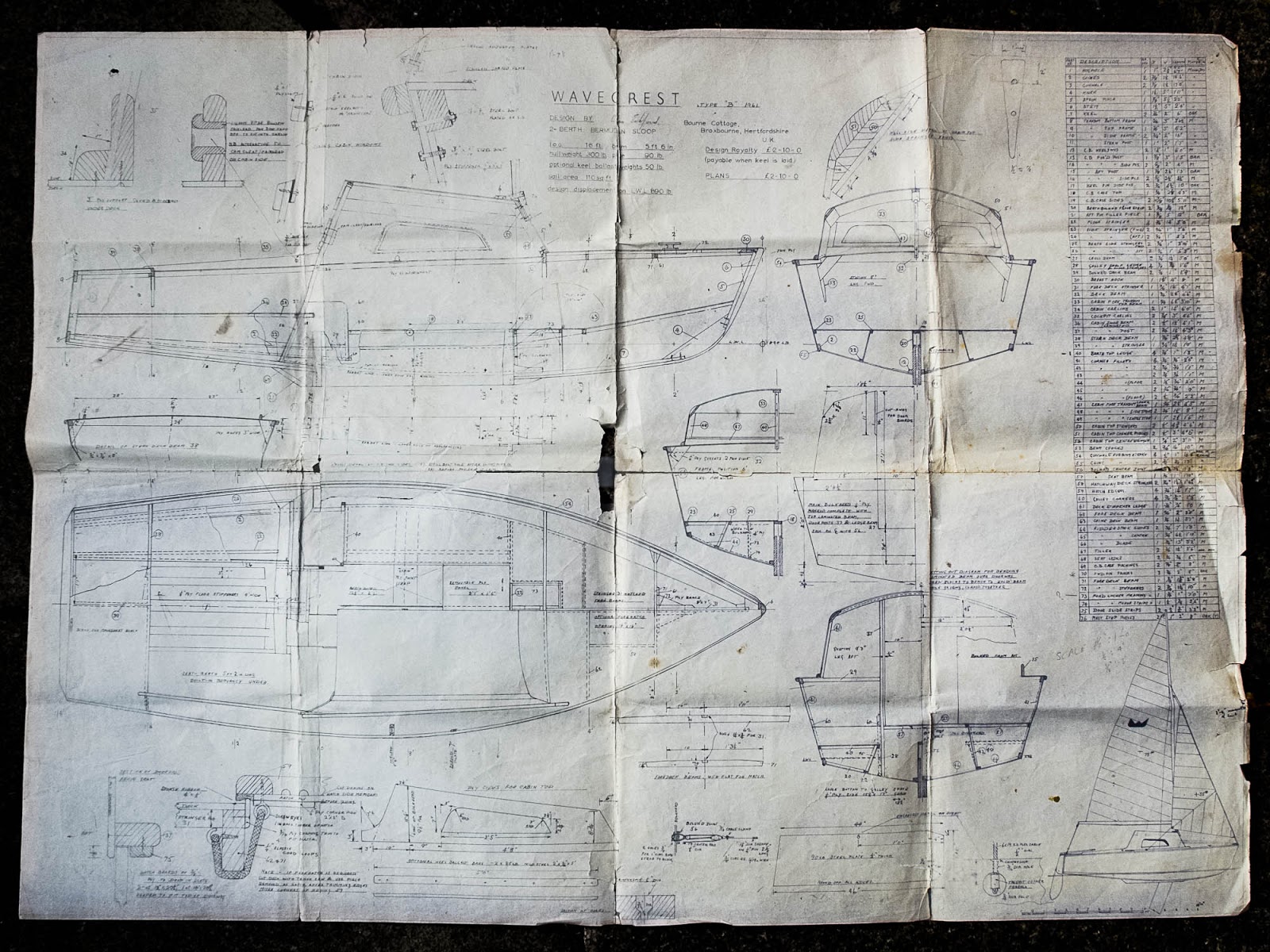
We still have the original drawings, there are only two sheets but appear to show all the information needed to build the boat. On the reverse side we found some sketches by my father, which showed his ideas to help raise and lower the mast single handed. I can't remember doing this but the photographs and knowing there were a number of bridges  on the river, it is something he must have done on several occasions.


So impressed with Eckford's designs, my father later bought a Fleetwind as well. This is  Mike (again), sailing the boat on the Thames around 1966. I notice there is not a buoyancy aid or helmet in sight.


Resin - "The boat without fastenings"

 
Resin
 
We all take modern glues for granted and the ease we can now laminate wood. However, in the 1940's synthetic resin adhesives were very new. But during WWII Areolite 300 was developed and used in the construction of the Mosquito aircraft. To test the strength of this glue, the sales manager of Areo Research Ltd. (ARL) Mr. FB Priest built a 8ft 6inch dinghy called "Resin" in 1942.
 
The company was based near Cambridge and by 1959 the boat was owned by my father, who sailed it on the River Cam. The hull was cold moulded using two layers of 2inch wide plywood strips. The hull weighed only 62lb once finished.
 
The photographs below were taken for publication in 1960 by ARL to show the durability of this method of construction. Other boats such as motor torpedo boats and also gliders used the glue. The glue has now developed into Areolite 306.


This is a copy of an article from "Motor Boat and Yachting", printed in November 1945.

Sunday, 20 September 2015

A weekend at Coniston


This photo shows the medium sized Performance Blue halyard bag we'd added to the inside port bulkhead. Perfect size and excellent quality, ideal for the VHF and other items.


While in Scotland we treated the boat to a ratchet block on the mainsheet. Much of the time the ratchet is in the off position. However, once the wind gets up it has proved very useful and encourages the helm not to cleat the sheet. There have been cases of a Coaster capsizing and I don't believe self rescue is an option. These capsizes have occurred in gusty conditions and also where sails have been cleated. Some boats use dinghy style jib fairleads and cleats, which are difficult to release once the boat is healing. Using the centre winch and simple clamcleat, as originally fitted by the factory, makes it much easier to release the jib quickly. Some feel that easing the jib is a good option when the wind gusts, as this will actually cause the boat to luff up. Having now fitted the high peak main, this now gives another option, which is to "scandalise" the sail, by dropping the gaff slightly and de-powering the top of the sail very quickly.